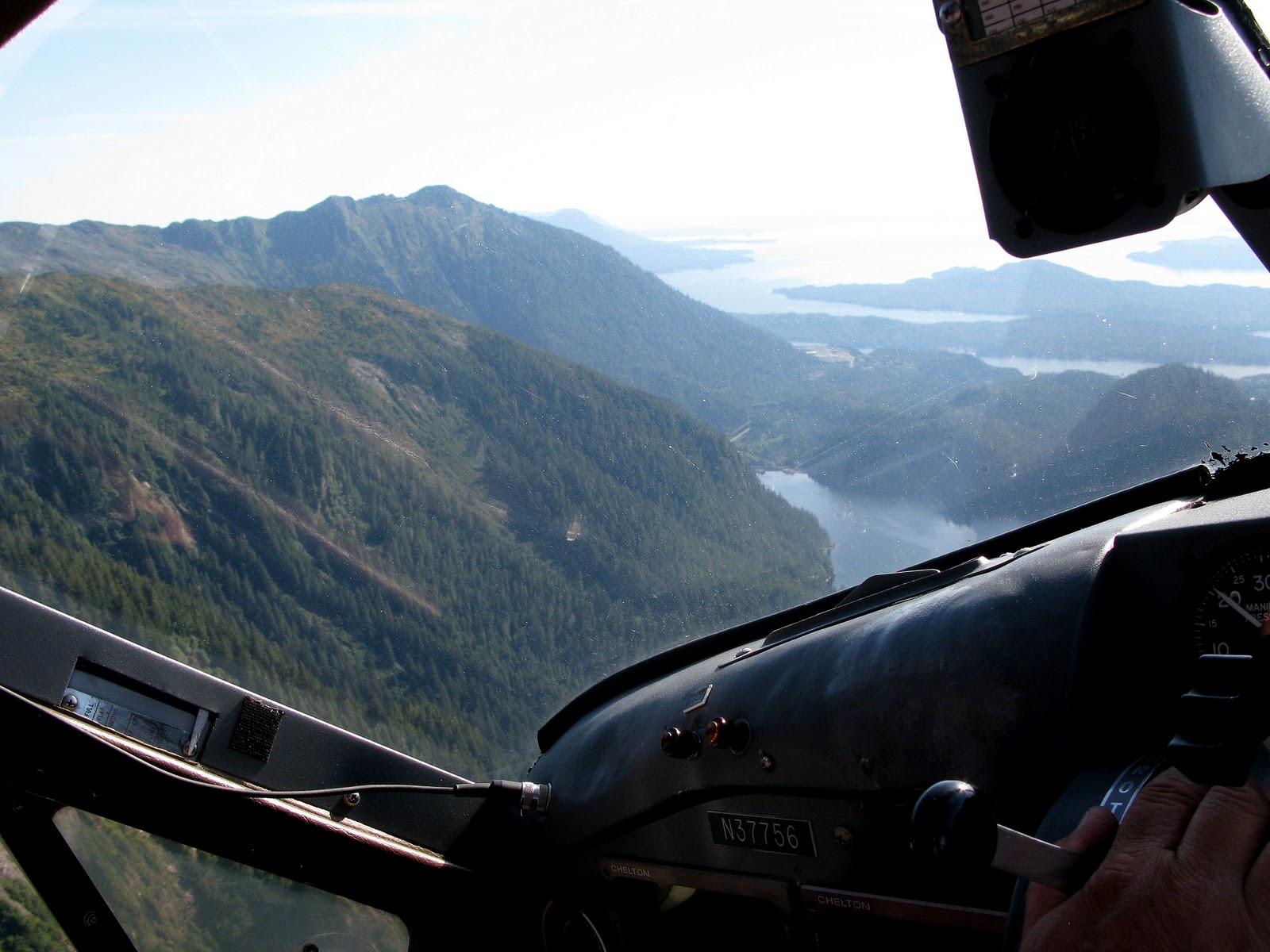
We got home from Alaska and British Columbia on the evening of September 21, and on the morning of September 28 we hit the road again. This trip would take us back to western Canada, followed by one week each in Washington, D.C., Boston, and southern Vermont. We would be away from home for the entire month of October, returning in early November.
The timing was prompted by the fact that the Lexington Group (consisting of railroad writers, historians and current and former railroaders) was holding its four-day annual meeting in Calgary, hosted by Canadian Pacific Railway. Since CP is one of Tom's favorite railroads, we had to be there.
Most of the meetings were held at the Fairmont Palliser Hotel, a former Canadian Pacific hotel in downtown Calgary that opened in 1914. Although the Palliser is no longer a CP property, as you walk around the building, you do find signs of its heritage as a railway hotel.
 The lobby is very traditional.
 For the first two days, Tom attended meeting presentations, many of them focused on railroad operations in western Canada, past and present. He also had a chance to reconnect with friends and colleagues from various places he worked during his railroad career.
Tom took some time off on the first afternoon of the meeting so that we could go to the Glenbow Museum, just down the street from the hotel, to see an exhibit of works by the Colombian artist and sculptor, Fernando Botero, whose specialty is the rotund human form. After our trip to Colombia earlier this year, where we saw Botero reproductions all over Bogotá and Cartagena...
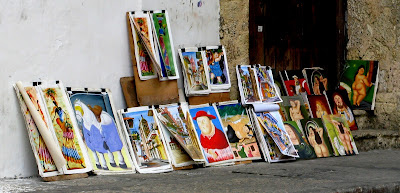 we were quite surprised to find a comprehensive exhibit of his work in Calgary. The Glenbow is one of the best museums we've been in, and while it emphasizes the art and culture of western Canada, it also devotes much of its space to works from other parts of the world.
The high point of the Lexington Group meeting came on the third day, with an “inspection trip” of the 82-mile CP route from Calgary to Banff. This would take us over the CP line along the Bow River, across the prairie immediately west of the city and into the mountains as we approached Banff. The train consisted of coaches and former business cars from CP's fleet of preserved rail equipment. On the morning of the trip we learned that the train would be led by CP steam locomotive 2816 (constructed in 1930) as well as two 1950s-era diesels. Since the trip west from Calgary to Banff involved a gradual climb, the 2816 put on a good show.
 At Banff, the train let passengers disembark, and then backed up more than half a mile so that it could stage a full-speed runby. It was noisy and exciting!
 After the Lexington meeting, we left for Canmore, a town about 15 miles east of Banff, where we would spend the next week. We were still recovering from our summer in Alaska, so our objective was to relax. Canmore is a former coal mining town that has made the transition to being a vacation and retirement community. It's in a beautiful setting along the eastern edge of the Canadian Rockies...
 and we were glad that we stayed there rather than at Banff, which also has a beautiful setting but often seems rather crowded with tourists.
While we were there, Tom had a flareup of neck pain (a longstanding problem) that necessitated a trip to the local emergency room. We have a very positive opinion of Canadians, based on our past trips north of the border, and this impression was reinforced by how well we were treated by everyone we met at Canmore General Hospital. Fortunately, this happened on our first full day in town, so Tom had several days to recover, and by the end of the week he was back to normal.
This medical issue only reinforced our inclination to take it easy while we were in Canmore. However, we did venture out of Canmore on a couple of days - once to have lunch at the Chateau Lake Louise...

 and then for a similar trip to the Banff Springs Hotel.
 Both properties are former CP hotels, now operated by Fairmont. We arrived at Lake Louise early enough to get a prime window table overlooking the lake.

 The next day, we went to the Banff Springs and got another table with a great view for lunch in the Rundle Lounge. The food was good, but the service was leisurely - we spent over an hour waiting for our entrées, and it turned out that the server had lost track of our order. She made amends by giving us a discount on our lunch. Fortunately, there are far worse places to have to wait for lunch than the Rundle Lounge, with its view of the Bow River Valley and surrounding mountains.
 At the end of our stay in Canmore, we drove to Calgary and boarded a flight to Chicago, where we changed planes for Washington, D.C. Our hotel for the first night was across I-395 from the Pentagon.
 We could look out from our room and see the Kennedy Center and Lincoln Memorial beyond the Pentagon, and to the east, the Washington Monument and Jefferson Memorial.
 We spent the next several days visiting friends in D.C. and northern Virginia. After the first night, we stayed with our longtime friends Peggy and Ira in Northwest Washington. In addition to us, they were also acting as hosts to a young woman who has started working for the federal government in the Washington area. Four years ago, Peggy and Ira had been kind enough to host our son Ricky while he interned in Washington during his second summer of law school.
One of our priorities for this trip was to visit the Newseum, which is a museum devoted to covering the journalism business. It has several floors devoted to different aspects of the news, with special areas set aside to cover topics such as the events of September 11, 2001, including the antenna mast that stood atop the North Tower of the World Trade Center...
 Hurricane Katrina, including an example of the signs that New Orleans residents put on their houses to keep looters away...
 and freedom of the press, including a map showing the relative freedom that journalists have in countries around the world.
 Other exhibits cover the Berlin Wall; the transition to electronic media; Pulitzer Prize-winning news photos; and the stories of journalists who have been killed while covering the news. There was so much to see, and we enjoyed it so much, that we went back for a second visit.
Standing on the 6th-floor balcony overlooking Pennsylvania Avenue, you get a great view of the Capitol Building.

 Not far from the Newseum, we discovered the National Building Museum, which hosts exhibits dedicated to various aspects of architecture and also acts as a forum for the exchange of ideas about the man-made environment. It's in the former Pension Bureau Building, built in the 1880s, which is a beautiful brick structure covering almost an entire city block.
 We weren't able to spend much time there, but we were struck by the gorgeous interior of the building, which has been used for inaugural balls and other formal events.
 After six days in D.C., we boarded Amtrak's Acela for the six-and-a-half hour, 456-mile trip to Boston.
 This was our second trip on the Acela. For a trip like this, the extra money seemed worth it - not only in terms of getting to Boston a couple of hours faster than the lower-priced regional train, but also for the sake of the more comfortable seating and the wireless Internet service.
We passed through Manhattan underground, but after we emerged from the East River tunnel in Queens, we got a nice view of the New York skyline.
 We arrived in Boston on time. That allowed us to connect with Ricky (who works in Boston), check into our room at Marriott's Custom House, and make the short trip on the subway (the “T” to Bostonians) over to Logan Airport. There, we met our sister-in-law Marilyn and her husband Michael, who had just flown in from Las Vegas to spend a few days in New England.
We brought them into the city, left their luggage in our room and found a neat place for dinner - a bar called Jose McIntyre's, which was offering a one-and-a-quarter pound boiled lobster for the bargain price of $10. Marilyn and Michael were staying at a hotel in Quincy, south of the city. That happens to be where Ricky lives, so he accompanied them on the T to Quincy and then took them to the hotel.
The Custom House is an iconic Boston building, located near the waterfront and only a few steps from Quincy Market and Faneuil Hall. If you've ever seen a movie or TV show set in Boston, you've probably seen the Custom House as the camera pans over the city's skyline.
 The base of the building is a domed three-story structure that opened in 1849. The federal government added the tower in 1915 and used the Custom House as one of its principal office buildings in Boston from 1915 until the mid-1980s. It then vacated the building, and the Custom House sat empty and abandoned for more than ten years. Today, it is owned by the City of Boston and leased to Marriott, which spent millions of dollars to renovate it in the late 1990s, and now operates it as a timeshare property.
From the building's 26th-floor observation deck, you get wonderful views of the city, including Faneuil Hall...
 as well as the steeple of Old North Church ("one if by land, two if by sea") and, beyond it, the U.S.S. Constitution ("Old Ironsides") at its berth in Charlestown.
 On the first full day of our visit, we went to the Saturday produce market at Haymarket, a few minutes from the Custom House, and in the afternoon Ricky drove us out to Concord for a get-together among the Mattsons (Marcia's father's family). We first stopped in Lexington to connect with one of Marcia's cousins, and then proceeded to the Colonial Inn in Concord for dinner.

 Marcia is the youngest of five cousins on this side of the family, and aside from her, they all live in Massachusetts. It was fun visiting with the other cousins and their spouses, since we see them so irregularly. This dinner was particularly special since Marilyn and Michael were there, too.
On Sunday we had brunch with Tom's brother Chris, who lives in East Boston. He is friendly with the family that operates a wonderful Mexican restaurant, Angela's Café. In fact, he made the restaurant's signs, including this one.
 We always go there for a meal when we are in East Boston.
On Monday, we went to the North End, Boston's Italian section, for lunch with Marilyn and Michael, and Marcia then took the two of them to the John F. Kennedy Presidential Library and Museum.
Later in the week, we visited another of Marcia's cousins at her home in Nahant, an island community near Salem that's connected to the mainland by a causeway. She served us lobster rolls, which were a great treat.
On Tuesday, we took the ferry to Charlestown, a quick ten-minute ride but easily one of the best tourist bargains ($1.70 per person) in Boston. The ferry gives you a view of the Boston skyline...
 including the Custom House and nearby buildings...
 and the Leonard P. Zakim Bunker Hill Memorial Bridge, which was constructed as part of the Big Dig expressway project.
 The towers of the Zakim bridge echo the most prominent feature of Charlestown, the Bunker Hill Monument, one of the most prominent local symbols of the American Revolution.
 Nearby plaques memorialize those killed in the Battle of Bunker Hill in June 1775.
 Despite having grown up in Massachusetts, we had never been to Charlestown. Contrary to the image of Charlestown conveyed in Ben Affleck's recent movie, The Town, the neighborhood around the monument is very nice, with many historic houses that have been nicely maintained by their owners. It's easily as pretty as Beacon Hill and other desirable Boston neighborhoods.
 The Zakim Bridge is prominent as you walk along many of Charlestown's streets.
 We walked back to Boston, crossing the Charles River over the Charlestown bridge...
 where the red stripe along the sidewalk marks it as one link in the Freedom Trail.
 On our way back to the Custom House, we passed some of the upscale condominiums that have been developed along the historic wharves lining the harbor.
 Here's a view of this area from the observation deck of the Custom House:
 As we walked around Boston, one of the things we enjoyed the most was how many historic buildings had been preserved, either for their original purpose or for some creative reuse. The Custom House is a prime example of how buildings have been adapted for new uses, as is the Liberty Hotel, which was once the Charles Street Jail.
 Everywhere you look around the city, there's an example of traditional architecture and, right next to it, a more modern building. Just up State Street from the Custom House, for example, sits the Old State House, dwarfed by surrounding office buildings.
 About a mile away, the Arlington Street Church, built just before the Civil War, marks one end of the upscale shopping areas along Boylston and Newbury streets.
 Although it was late October, there was some surprisingly colorful foliage around the city.
 On our last full day in Boston, we took a walking tour with the concierge from the Custom House. Earlier, from our room, we had seen the U.S.S. Constitution making its way through Boston Harbor, preceded by a Boston city fireboat. This is a rare event, but it hadn't been publicized ahead of time.
 Our walking tour took us along the wharves and piers adjacent to the North End, and as we made our way, the Constitution was returning to Charlestown, so we got a good look at it. To our surprise, it paused for a time to fire its cannon in salute near the Coast Guard station at Battery Wharf, where the Constitution was launched in 1797. The cannon were on the opposite side of the ship from where we stood, but they left a smokey haze in the air off the ship's bow.
 Our next major destination was Mt. Snow, Vermont, where we would spend our last week in New England. On our way, we stopped to see a younger generation of Marcia's cousins, in Brewster, Massachusetts, and Granby, Connecticut. We had a great time visiting with each of them.
We hadn't been to Vermont in years, so it was fun being there although in most places the fall foliage was well past its peak. We used Mt. Snow as a base to visit various places around the state, including Middlebury, where we had lunch with Tom's sister Carol and her husband Greg, and Montpelier, where we visited a former teaching aide of Marcia's who has a new baby. We also went to Chester, where we both remembered (but couldn't find) a neighborhood with many old stone houses, and Brattleboro, where we were impressed by the fact that we could stand in the main parking lot in the center of town and see four independent bookstores.
On the day we drove to Montpelier, we stopped for lunch at the general store in Pittsfield, which advertises itself as a source for everything from maple syrup to gun powder.

 We spent one day visiting Bennington, which has its own Revolutionary War memorial obelisk, commemorating the Battle of Bennington in August 1777.
 The foliage was still quite vivid in the neighborhood near the monument.

 We had a couple of rainy days while we were in Vermont, but even on those days, there was some color.
 When we left Vermont, we headed for Boston, where we would spend two more days before flying back to California. Along the way, we stopped for a wonderful dinner with a high school friend and her husband in Holden (where Tom grew up). The next evening, we had dinner with Ricky and his girlfriend at an Italian restaurant, Alfredo's in Quincy, where we ate in the bar. We felt like the only outsiders there - everyone else seemed to know each other, and we would guess that many of them had been coming to Alfredo's for decades.
Our last Boston-area meal was an excellent seafood dinner at the Cambridge branch of Legal Sea Foods with Ricky and Chris. The next day, we boarded a Boston-to-Los Angeles flight, and at LAX we transferred to our 30-seat commuter flight to Santa Maria. Finally, after being away from home for almost six months (except for that brief six-day visit in September), we were home. We had made it back in time for the last couple of days of warm weather (upper 80s) before the rainy and cold (by California standards) season would be upon us.
In our first few days home we enjoyed local strawberries, raspberries, apples, lettuce, tomatoes, green beans and other treats from nearby farmers' markets. Hmmm... not only do we associate travel with food, but we also seem to make that association when we think of our California home. Well, it's always nice to have something to look forward to, whether we're on our way to a new destination, or on our way home!
The timing was prompted by the fact that the Lexington Group (consisting of railroad writers, historians and current and former railroaders) was holding its four-day annual meeting in Calgary, hosted by Canadian Pacific Railway. Since CP is one of Tom's favorite railroads, we had to be there.
Most of the meetings were held at the Fairmont Palliser Hotel, a former Canadian Pacific hotel in downtown Calgary that opened in 1914. Although the Palliser is no longer a CP property, as you walk around the building, you do find signs of its heritage as a railway hotel.
(click on any photo to enlarge)


Tom took some time off on the first afternoon of the meeting so that we could go to the Glenbow Museum, just down the street from the hotel, to see an exhibit of works by the Colombian artist and sculptor, Fernando Botero, whose specialty is the rotund human form. After our trip to Colombia earlier this year, where we saw Botero reproductions all over Bogotá and Cartagena...

The high point of the Lexington Group meeting came on the third day, with an “inspection trip” of the 82-mile CP route from Calgary to Banff. This would take us over the CP line along the Bow River, across the prairie immediately west of the city and into the mountains as we approached Banff. The train consisted of coaches and former business cars from CP's fleet of preserved rail equipment. On the morning of the trip we learned that the train would be led by CP steam locomotive 2816 (constructed in 1930) as well as two 1950s-era diesels. Since the trip west from Calgary to Banff involved a gradual climb, the 2816 put on a good show.


While we were there, Tom had a flareup of neck pain (a longstanding problem) that necessitated a trip to the local emergency room. We have a very positive opinion of Canadians, based on our past trips north of the border, and this impression was reinforced by how well we were treated by everyone we met at Canmore General Hospital. Fortunately, this happened on our first full day in town, so Tom had several days to recover, and by the end of the week he was back to normal.
This medical issue only reinforced our inclination to take it easy while we were in Canmore. However, we did venture out of Canmore on a couple of days - once to have lunch at the Chateau Lake Louise...


One of our priorities for this trip was to visit the Newseum, which is a museum devoted to covering the journalism business. It has several floors devoted to different aspects of the news, with special areas set aside to cover topics such as the events of September 11, 2001, including the antenna mast that stood atop the North Tower of the World Trade Center...


Standing on the 6th-floor balcony overlooking Pennsylvania Avenue, you get a great view of the Capitol Building.


We passed through Manhattan underground, but after we emerged from the East River tunnel in Queens, we got a nice view of the New York skyline.

We brought them into the city, left their luggage in our room and found a neat place for dinner - a bar called Jose McIntyre's, which was offering a one-and-a-quarter pound boiled lobster for the bargain price of $10. Marilyn and Michael were staying at a hotel in Quincy, south of the city. That happens to be where Ricky lives, so he accompanied them on the T to Quincy and then took them to the hotel.
The Custom House is an iconic Boston building, located near the waterfront and only a few steps from Quincy Market and Faneuil Hall. If you've ever seen a movie or TV show set in Boston, you've probably seen the Custom House as the camera pans over the city's skyline.

From the building's 26th-floor observation deck, you get wonderful views of the city, including Faneuil Hall...


On Sunday we had brunch with Tom's brother Chris, who lives in East Boston. He is friendly with the family that operates a wonderful Mexican restaurant, Angela's Café. In fact, he made the restaurant's signs, including this one.

On Monday, we went to the North End, Boston's Italian section, for lunch with Marilyn and Michael, and Marcia then took the two of them to the John F. Kennedy Presidential Library and Museum.
Later in the week, we visited another of Marcia's cousins at her home in Nahant, an island community near Salem that's connected to the mainland by a causeway. She served us lobster rolls, which were a great treat.
On Tuesday, we took the ferry to Charlestown, a quick ten-minute ride but easily one of the best tourist bargains ($1.70 per person) in Boston. The ferry gives you a view of the Boston skyline...


We hadn't been to Vermont in years, so it was fun being there although in most places the fall foliage was well past its peak. We used Mt. Snow as a base to visit various places around the state, including Middlebury, where we had lunch with Tom's sister Carol and her husband Greg, and Montpelier, where we visited a former teaching aide of Marcia's who has a new baby. We also went to Chester, where we both remembered (but couldn't find) a neighborhood with many old stone houses, and Brattleboro, where we were impressed by the fact that we could stand in the main parking lot in the center of town and see four independent bookstores.
On the day we drove to Montpelier, we stopped for lunch at the general store in Pittsfield, which advertises itself as a source for everything from maple syrup to gun powder.


Our last Boston-area meal was an excellent seafood dinner at the Cambridge branch of Legal Sea Foods with Ricky and Chris. The next day, we boarded a Boston-to-Los Angeles flight, and at LAX we transferred to our 30-seat commuter flight to Santa Maria. Finally, after being away from home for almost six months (except for that brief six-day visit in September), we were home. We had made it back in time for the last couple of days of warm weather (upper 80s) before the rainy and cold (by California standards) season would be upon us.
In our first few days home we enjoyed local strawberries, raspberries, apples, lettuce, tomatoes, green beans and other treats from nearby farmers' markets. Hmmm... not only do we associate travel with food, but we also seem to make that association when we think of our California home. Well, it's always nice to have something to look forward to, whether we're on our way to a new destination, or on our way home!
Text and images ©2010 Tom and Marcia Murray