Showing posts with label Alaska. Show all posts

Monday, September 27, 2010

September 2010: Alaska, Part 3

As the summer continued, we were glad that we had done so many things during our first few weeks in Alaska. By late June, discounts on lodging, boat cruises and other activities were becoming harder to find. And the weather got wetter – there were weeks when we never saw the sun. But we still found plenty to do.

We returned several times to the Alaska SeaLife Center in Seward. Watching the sea birds and marine mammals there was always entertaining. In addition to the public viewing areas, the Center also offers behind-the-scenes tours, each one focusing on a different type of animal. We decided to do a “puffin encounter,” a private tour that would give us a closer look at these appealing birds. It's limited to four people; our guide was an “avian intern” who plans to become a veterinarian.

The SeaLife Center is a public aquarium but it also has a research staff that deals mainly with populations that are declining or endangered. The Center also serves as a place for injured birds and mammals to recover. Our guide first gave us a tour of the research facilities, and we then had an opportunity to enter the public aviary through a back door, where we could feed the birds. The aviary holds a variety of birds native to the Bering Sea area, including murres, kittiwakes, harlequin ducks, and the stars of the show, the puffins.
(click on any photo to enlarge)
Each of us had a bowl of small fish, and within seconds, we were surrounded by birds wanting to be fed. As we held the fish by the tail with the heads pointing out, the birds came right up and took the fish from our hands and swallowed them whole. The ducks stayed in the water, so we threw fish out for them. We spent about 20 minutes there, especially enjoying the company of a very curious rhinoceros auklet, which would have sat in Marcia's lap if she had let it. He didn't want to eat anything, but he did want to sit as close as possible.
Our next animal encounter involved sled dogs. In early July, our daughter Lindy and her boyfriend Eddie came to Alaska. While they were there we visited the training facility operated by the Seavey family, which has been involved in the Iditarod and other competitive sled dog events for many years. The facility is currently home to about 80 dogs. That sounds like a lot, but we learned that the secret of success in sled dog racing is to assemble teams that have a variety of attributes, so that each dog complements its teammates in terms of speed, endurance, temperament, leadership and other characteristics. The humans who run these races are constantly adjusting their dog teams to come up with the best mix of animals.

On our visit, we first learned a little about the Iditarod, and then went to the dog yard. The dogs were very excited to have us in there, so it was noisy and very active, with dogs jumping and pulling at their leads to get attention. The lead dog was chosen first, and he settled down and rested while waiting for the others to be hooked up. We were pulled on a two-mile course in a six-person cart with the guide at the back.
It was interesting watching the dogs' behavior. When one went right or left, the team followed – the dogs clearly knew to follow the leader. But occasionally things didn't go according to plan, as when one young dog crossed over to the wrong side of the lead, requiring our guide to stop and untangle him. Our guide was excellent, explaining what was going on and demonstrating the equipment needed for the Iditarod. We also got a chance to see and hold six-week old puppies, which were surprisingly docile given the excitable nature of the dogs in the yard.
While Lindy and Eddie were there, they went on a Resurrection Bay cruise, as did Tom's brother Kip, who arrived later the same week. We had been having one rainy day after another, but fortunately the sun broke through for both of their cruises. And all three of our visitors reported that they had a great time on their brief visits to Alaska.

Later in the summer, our son Ricky and his girlfriend Leslie visited us. Unfortunately, they got a full dose of Seward's “liquid sunshine.” Leslie went kayaking on her first full day in Seward and by the time she was finished she had to buy a couple of new items of clothing because she had gotten soaked to the skin from the rain. But she and Ricky were still smiling at the end of their visit!
Between these visits from family members, we traveled to Homer, on the west side of the Kenai Peninsula (Seward is on the east side). The air distance between the two towns is only 85 miles, but the road between the two adds almost 100 miles to that distance, since the direct route would involve crossing several mountains as well as the Harding Ice Field. The drive was a scenic one, particularly the section from Kenai to Homer, where the road runs along Cook Inlet. On the opposite side of the inlet are two 10,000-foot volcanoes, Redoubt and Iliamna. Mount Redoubt made the news in March 2009 when it spewed ash into the air for several days, disrupting air travel in Alaska. Iliamna regularly emits gases and condensate.

This part of the Kenai Peninsula had several Russian settlements prior to the purchase of Alaska by the United States in 1867, including Ninilchik, where this Russian Orthodox Church still holds services. In the background of this photo is Mount Iliamna.
The entrance to Homer is a dramatic one. As you enter town, the mountains on the opposite side of Kachemak Bay come into view.
At the far end of town is the Spit, a natural sand bar more than 4 miles in length that has become home to many of Homer's fishing and boating services as well as restaurants, bars and other tourist-related businesses.
We stayed at a B & B on a bluff overlooking the bay. Homer has a large population of bald eagles, one of which had taken up residence in a tall evergreen in back of the B & B.
Eagles like to perch in trees near the water so that they can readily spot fish. This eagle took flight several times as we watched it, swooping down to the bay for some fresh fish, but each time it returned to its chosen spot in the tree.
At both Homer and Seward, one of the main drivers of the economy, at least during the summer, is sport fishing, mainly for salmon and halibut. Visitors can spend several hundred dollars each to charter boats for all-day fishing trips out into local waters as well as into the Gulf of Alaska. If they're lucky, they'll return with a hundred pounds or more of fish. Some halibut go as large as 300 pounds or more, so a single fish may be enough to provide a nice return on the cost of the charter.

For the most part, we limited our fish-related activities to eating copious amounts of both species (as well as lots of king crab and snow crab). However, even though we didn't do any fishing, we did have an opportunity to participate in one important fishing event while we were in Seward: the annual Silver Salmon Derby. The derby extends over several days and provides prizes for the largest fish as well as other incentives aimed at filling up the charter boats. We volunteered to sell tickets at the derby office one night (the proceeds from the derby go to local organizations). However, Tom got drafted to weigh fish, and despite his inexperience in this area, he didn't get any complaints from the derby participants.
(photo by Nancy Steeves)
We made several trips on the Alaska Railroad during our 18 weeks in the 49th state. One of the more interesting trains we rode was the Glacier Discovery. It leaves Anchorage in mid-morning to take people to Whittier for day cruises on Prince William Sound. It then proceeds toward Spencer Glacier, where it drops people off to hike and go rafting on the Placer River. The "whistle stop" near the glacier has recently been improved by the U.S. Forest Service, which is trying to encourage visitation in this roadless section of the Chugach National Forest.

The Forest Service also helped finance a double-deck self-propelled railcar, the Chugach Explorer, which has helped boost ridership on the train. Here, the train is arriving back at Portage from its morning run to Whittier. In the background is Burns Glacier.
After leaving the Spencer Glacier stop, the train proceeded up the hill to a location called Grandview. Along the way, we passed through five tunnels, and got a good view of Bartlett Glacier. At the top of the hill the train reversed direction, made a stop at Spencer Glacier to pick up hikers, and then made one more stop to pick up river rafters.
Even more fun was another Alaska Railroad train that serves a remote area, the Hurricane Turn. It operates from Talkeetna, a gateway to Denali National Park, northward along the Susitna River to the town of Hurricane, a distance of 55 miles.

To get to Talkeetna, we rode two other Alaska Railroad trains, the Coastal Classic from Seward to Anchorage, and the Denali Star from Anchorage to Talkeetna. As we neared Talkeetna on the Denali Star, we got a great view of Denali (Mount McKinley) from the train.
In Talkeetna, we stayed at Talkeetna Alaskan Lodge, which is an affiliate of the lodge where we worked, Seward Windsong. Both are owned by Alaska Native corporation CIRI (Cook Inlet Region, Inc.). The two lodges are very different - Seward Windsong has 180 rooms distributed among 15 buildings in a forested setting, while Talkeetna Alaskan has most of its 212 rooms in a single building, evoking in scale and spirit some of the grand lodges of the national parks.
The town of Talkeetna is reputed to have been one of the inspirations for the TV series Northern Exposure. It was once home to miners and other early settlers who came to this part of Alaska in search of riches, or just a new start, and many of the buildings in town date to the early 20th century. Today, these buildings are occupied by shops, restaurants, and other businesses serving the tourist industry.
But north of Talkeetna, along the route of the Hurricane Turn, little has changed over the past decades. People come to this area to camp, fish and hunt, and a few hardy souls have made their homes in this roadless part of Alaska. The Hurricane Turn operates four days a week during the summer to serve this population (from mid-September to mid-May, people who need to travel to and from this area use the weekly Anchorage-Fairbanks train as well as a monthly Hurricane Turn). This spot along the Indian River, 43 miles north of Talkeetna, is typical of the places where the train stops.
Riding this train was a treat. Unlike the Alaska Railroad's other trains, which largely serve tourists from outside the state, the riders on this train consisted of outdoors enthusiasts who have adopted the Alaska way of life (as well as a few other day-trippers like us). Many of the train's regular riders rode in the baggage car along with their dogs, their fishing and hunting gear, their supplies (food, beer, lumber, etc.) and their coolers.
The train stops wherever anyone wants to get off, or wherever a rider is waiting to flag it down (hence the train's reputation as the last true flagstop train in North America). One of the riders was a man who had been living in the back country for several months and was headed back to civilization. Among his possessions were two bear skulls. One, he said, he had found in the woods. The other came from a bear he had shot. “She just wouldn't leave my camp alone,” he said (Alaskans are allowed to shoot bears that threaten human life or personal property).
In addition to campers and other transients, some people live along this stretch of the railroad, including author Mary Lovel and artist Shannon Cartwright. Occasionally the railroad gets involved in a medical evacuation or other emergency response to assist these backwoods residents, who have made the choice to live without the conveniences that the rest of us take for granted.

In addition to taking out-of-town trips, we also spent a few of our days off in Seward. When we did this, we always found someplace to stay other than our cabin. Sometimes this meant checking into a room at our own lodge (very nice!), and on a few occasions we sampled other lodging places around town. One of the nicest places we found was Adams Street B & B. It's near downtown Seward but right across the street from Resurrection Bay. It's owned by a couple (Judy and Don) who live in Anchorage most of the year but run the B & B during the summer. We can highly recommend it as a warm, hospitable place to spend a few days in Seward.
Late in the season, we stayed at a lodging place down the road from our own lodge. By this time, black bears had started coming to Seward, looking for food as they started to bulk up for their winter hibernation. Strangely, many places in town have dumpsters that are not bear-proof, and from the porch at the lodge we watched as one bear explored the dumpster (apparently finding some tasty morsels, given how long he spent there)...
...and then being treed by a couple of dogs.
The Alaska tourist season lasts roughly four months, from mid-May to mid-September. By early September, many of Seward's restaurants and shops had closed or cut back their hours, and our lodge closed on September 13. We left a day early, on the 12th, in order to take the last cruise of the season from Seward to Vancouver, on Holland-America's MS Statendam (shown here at our first port of call on this cruise, Haines).
We expected cold, rainy weather on this trip, but we thought that spending a week on the ship would be a relaxing way to end our summer in Alaska. Were we ever wrong about the weather! During our last two weeks in Seward, we had seen a big change, with many warm, sunny days, and that trend continued as we cruised south toward Vancouver. Temperatures were in the 70s, and we had one bright sunny day after another. At each port of call - Haines, Juneau, and Ketchikan - we took advantage of the weather to get off the ship and take one last look at what Alaska had to offer.

On our first two days after leaving Seward, we spent some time looking at glaciers, first in College Fjord (an arm of Prince William Sound) and then in Glacier Bay National Park. The glaciers in College Fjord are all named after eastern colleges and represent one of the biggest aggregations of tidewater glaciers in Alaska. We arrived there shortly after 6 A.M., just as the sun was beginning to hit the tops of the mountains.
In Glacier Bay, we cruised slowly toward the Johns Hopkins glacier, and spent an hour watching the glacier calve. We heard the ice breaking, and saw some splashes, but there weren't any of the spectacular ice cascades that you sometimes see in photos and videos of the tidewater glaciers.
Still, spending this gorgeous day surrounded by snow-covered mountains and glaciers was more than OK.
On our third morning out of Seward, we arrived at our first port of call, Haines. It's on the Lynn Canal, close to the north end of the Inside Passage. Marcia spent the day exploring this small town, enjoying the 75-degree weather (the warmest we had experienced since arriving in Alaska in May). Tom took a ferry to nearby Skagway to ride the White Pass and Yukon Railway. This was something we had both done in 2006, on our previous Alaska cruise, and Marcia decided that she didn't need to repeat the experience. But Tom had a great time riding the train to White Pass (elevation 2,865 feet), on the Alaska-British Columbia border.
When he returned to Skagway, he watched the railway's afternoon fleet of five trains leave for the summit.
The next day, we were in Juneau, where we explored the town (the only state capital in the U.S. that can only be reached by air or water) and took the tramway to the summit of Mount Roberts.
We had lunch at the Baranof Hotel and then Tom explored the neighborhoods near downtown Juneau while Marcia visited some of the shops.

Our final port of call was Ketchikan, and here, too, we had warm, sunny weather (after experiencing the wettest summer we've ever seen, each sunny day seemed like a gift). We had scheduled a visit to George Inlet Lodge, about 10 miles out of town, for a lunch of Dungeness crab, and we knew we would be returning via float plane. The lunch turned out to be a feast, with each of us consuming an entire crab. Even after a summer of wonderful seafood in Seward, this was a memorable meal.
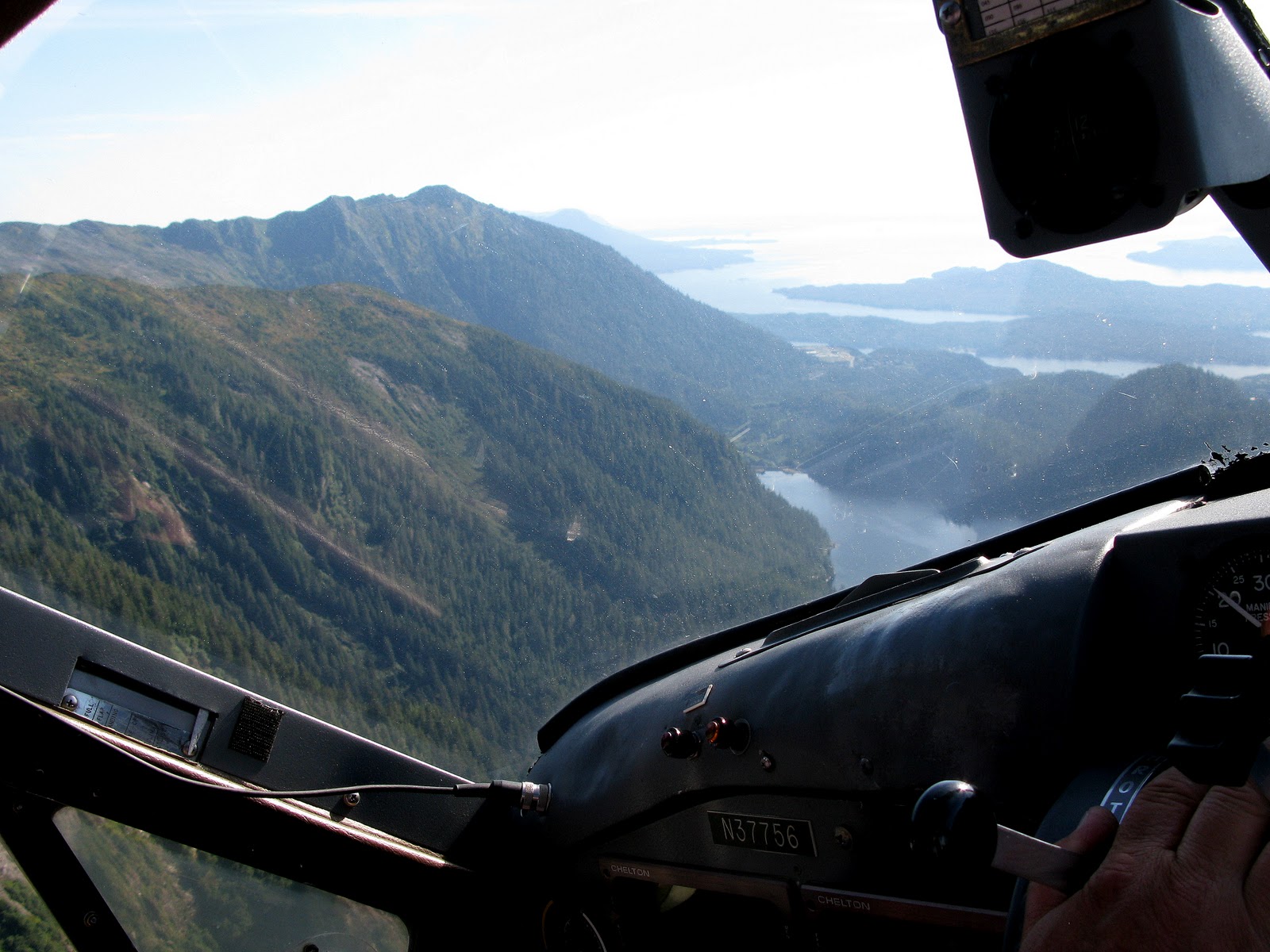
When we were done, we boarded a six-seat de Havilland Beaver float plane. These aircraft are the workhorses of the Alaska air fleet, even though they are all more than 40 years old.
Tom scored the co-pilot's seat, and he savored every moment of the flight as we took a tour of the mountains, islands and channels south of Ketchikan.

Marcia sat toward the back of the plane, and while small planes are not her favorite method of transportation, she enjoyed the flight, too.

We spent the next day in the passage between mainland British Columbia and Vancouver Island, and on Sunday morning we arrived at Vancouver. It was raining hard when we disembarked from the ship, but we didn't mind.

The next day we boarded the ferry for Swartz Bay, near Victoria, where we met our friends George and Dorothea, who we had first gotten acquainted with in 2007, when we took the Rocky Mountaineer train from Jasper to Vancouver. They are wonderful hosts, and they took us on a tour of lower Vancouver Island, ending with a beachside picnic at a provincial park with a view of Washington's Olympic Peninsula across the Juan de Fuca Strait.
The featured item was salmon dip (made with fish caught and smoked by George), and at dinner that evening we enjoyed crab and prawns, also caught by George.

The next day we said goodbye to them, and boarded a Victoria-to-San Francisco flight. At SFO we changed planes for a short flight to San Luis Obispo, and arrived home in Santa Maria about 9 P.M. It was September 21st, and we had been away from home since May 6th.

Our four-and-a-half month trip had been everything we had hoped for, and more. We enjoyed our jobs, as well as the people we worked with and the visitors we met at the lodge. And we came away understanding a little better what makes Alaska, and Alaskans, special. The weather, of course is a factor in their lives, but Alaskans don't let it interfere with their plans. They don't use umbrellas, they don't complain about the weather and they couldn't be happy living anywhere else. Living in the 49th state is not easy, especially for the 50 percent of the state's population that doesn't live in the state's one urban center, Anchorage. Most towns have only one road in and out, and if there's an avalanche, a flood, or a major storm, you're not going anywhere. The resources many of us take for granted in the lower 48 just don't exist in most of Alaska. You had better be self-reliant to live there. But as we noted in a previous post, the flip side of this spirit of self-reliance is that Alaskans are exceptionally kind to their neighbors, and even to visitors like us. We don't think we have what it takes to live in Alaska, but we felt very welcome there, and we do hope to return someday.

We'll leave you with this view of the sun setting over Turnagain Arm, south of Anchorage.
To see our other reports about our summer in Alaska, follow these links: Part 1; Part 2.

Text and images ©2010 Tom and Marcia Murray 


Thursday, July 1, 2010

June 2010: Alaska, Part 2

During our first six weeks in Alaska, we spent four of our weekends visiting interesting places within 100 miles of Seward. Our “weekend” is on Wednesday and Thursday, because those are relatively slow days at our lodge, but this works fine for us since those are the slow days in other tourist areas, too. Between mid-May and the end of June, we stayed in four very different lodging establishments, all of which were easier (and less expensive) to get into than they are now, with the tourist season in full swing.

There is only one road out of Seward, which leads to Anchorage. About 30 miles along the highway is a turnoff leading to the rest of the Kenai peninsula. We took that road to our first destination, the Kenai Princess Wilderness Lodge. It's located in the north central part of the Kenai Peninsula, at Cooper Landing. Its main function is to serve as a stopping-off point for Princess Cruise Lines customers who have booked land tour packages in connection with their cruises. But, just as at our lodge, each week has peaks and valleys of demand tied to cruise ship schedules. We took advantage of an Internet special to get into Kenai Princess on an off day.

It's in a beautiful location, on a bluff overlooking the Kenai River, which flows out of Kenai Lake, crosses the Kenai Peninsula and empties into Cook Inlet at the city of Kenai. Across the river is Mount Cecil Rhode, elevation 3,967 feet. Several of the mountains around the lodge had already lost most of their snow, although the north slope of Mount Cecil Rhode, facing the lodge, still had plenty of snow covering it.
(click on any photo to enlarge)
We arrived at mid-day and decided to spend our afternoon there, enjoying the warm, sunny weather.  We took a walk along the river, where the  color of the water reminded us of the ocean in parts of Hawaii, but that may have been partly because of the gorgeous blue sky.
The lodging units are in single-level buildings scattered around the property. At the front desk, we were warned not to disturb a mother and baby moose that had been seen near our unit, but we didn't spot them during our visit. The day was warm, but we couldn't pass up the opportunity to enjoy a wood fire in our room's stove.

We had rented a car to get to the lodge, and the next morning we headed toward Soldotna and Kenai, on the west side of the peninsula, both of which are population centers with many more stores than we have in Seward. We needed shelves for our cabin, as well as some other necessities, and this was as much a shopping expedition as a sightseeing trip. But we did enjoy getting a look at some unfamiliar territory.

This part of Alaska, adjacent to Cook Inlet, was home to several Russian communities prior to the U.S. purchase in 1867. In Kenai one of the landmarks is this Russian Orthodox church.
On our way back to Seward, we stopped in Cooper Landing to enjoy this view of Kenai Lake.
Our next weekend getaway was to Girdwood, about 40 miles southeast of Anchorage, and the home of the Alyeska Hotel. The hotel, which is part of a major ski complex, is a luxury property, but again we got in at an affordable price thanks to a midweek Internet special.

We - and Tom in particular - had been eager to ride the Alaska Railroad's Coastal Classic train, which runs between Seward and Anchorage. Our trip to the Alyeska was the perfect opportunity, since the train's only intermediate stop is at Girdwood. We left Seward on the train at 6:00 P.M., after a full day of work for both of us. It was raining, and there were many places where it seemed the water was going to overrun the rail bed. We wondered how the railroad's track maintenance forces could keep up with the conditions. Wet ground, standing water, rushing water, falling water... all along the way, there was water.
But it was very nice, sitting on the train having a sandwich and a glass of wine as we enjoyed the wet, wintry landscape through the large windows in the café car.
As we gained elevation, there was snow in the dark forest areas and later we saw a lot of snow in open areas as well. We saw one moose wading across a pond, but that was our only wildlife sighting.

Despite the rain, the scenery along the way was gorgeous. The train winds around tight curves where the railroad's builders had to find a workable route through the Kenai Mountains, climbing from sea level at Seward to an elevation of 1,063 feet at Grandview. Passengers can see glaciers and waterfalls from the train, and for those who didn't mind the cold winds, standing in the doorway of the train allowed a closeup view of the landscape.
We arrived at Girdwood around 9:00 PM, and got off the train along with a couple from Australia, also headed to the Alyeska. Just after the train left, a man drove up and asked if anyone else had gotten off the train. No, we said, we were the only ones. Well, the man said, where's my friend? We don't know, we replied. After we convinced him that his friend hadn't gotten off the train, he began to drive off. But just before he turned out of the parking lot, we looked up and saw the train (which had been gone for about five minutes) slowly backing up to the station. It stopped, and off got the man pictured below, who it turned out, had slept through the stop at Girdwood. When he awoke and told the conductor what had happened, the conductor had the train stopped, and then backed up to Girdwood to let the passenger off. Only in Alaska!
Although we've had a lot of rainy days since we've been in Alaska, we got lucky with the weather on both of our first two getaways. For this one, we had rain on the way up from Seward, as well as on the way back, but our day in Girdwood was sunny and warm.

It was definitely a slow week at the Alyeska, so we enjoyed exploring the hotel, the grounds around it, and the town of Girdwood without having to deal with crowds.
 
There's a tram to the top of the hill that serves skiers in winter and tourists in summer.
In addition to ski facilities, the top of the hill also features a restaurant, the Seven Glaciers, with wonderful food and great views. We got the best table in the house overlooking the mountains above the resort.
We both had a grape salad, Tom had king salmon with blueberry accented side dishes, and Marcia had king crab legs with spinach and citrus accents. So flavorful! We finished by sharing a key lime cheesecake served with tart lime mousse, and truffles at the end of the meal. A memorable experience (which, we decided toward the end of the meal would be our anniversary dinner for 2010 - after all, we aren't likely to have a more elegant dinner during our entire stay in Alaska).

There are lots of trails in and around Girdwood, so we explored one of them and enjoyed being in the forest, where trees and flowers were starting to come to life, and the creeks were full of water from spring snowmelt.

The rail trip back to Seward was full of scenic places; Marcia saw three moose at different places and a mother bear with two cubs crossing the track in front of us. The many curves in the track provided abundant opportunities for wildlife spotting. Tom did not see these due to his hanging out the Dutch door in the vestibule of the dome car, looking ahead at the train itself (not the wildlife). But despite focusing on the train, he did manage to capture some of the glacier-blue water along the right-of-way.
For our third weekend getaway, we went to Fox Island in Resurrection Bay, about 10 miles from Seward. Kenai Fjord Tours, a company affiliated with our lodge (they're both owned by an Alaska Native corporation, CIRI) operates many boat trips to see wildlife and glaciers in the bays, inlets and fjords near Seward, and on Fox Island they operate a wilderness lodge that is actually a nice little piece of civilization in a very beautiful natural setting. As CIRI employees, we got a substantial discount for this trip, which started with a boat ride from Seward, where we saw this bald eagle as we left the harbor...
... as well as a sea otter, floating on his back and looking at our boat.
The one-hour trip across the bay was followed by a lunch in the day lodge at Fox Island with about 80 other people off the boat.
After lunch, most of them got back on the boat to continue their tour while 12 of us lucky folks stayed on the island.

We were in a building with four lodging units including ours, Gray Whale. The room was spartan, but in a good way - all light wood walls, no extraneous furnishings, and plenty of space, with a table and chairs next to the window. This is the view from our window of the greenery and lagoon in back of our building.
After settling in we went for a walk along the rocky beach of Halibut Cove with a park ranger, who gave us much more information than we could absorb about the different types of seaweed, sea stars and other life forms that had washed up onto the rocks.


Even if we were not fully able to absorb what she was telling us, it was a delightful way to spend the afternoon.

Dinner that evening was in the main lodge building (not the day lodge where we had had lunch with the people from the boat). There were three other couples as well as a pair of women from Christchurch, New Zealand who were on a six-week North American tour. The entree was halibut, very nicely prepared.

After dinner we did more beach walking and then sat outside the lodge watching the sun sink over the mountains and glaciers on the other side of Resurrection Bay.
While sitting there, Marcia notice a large porcupine approaching us, and while we now know that the idea of a porcupine shooting its quills is a myth, we weren't about to find let him get too close, so we retired to our cabin.

From the cabin, the last bit of sunlight shining on a nearby mountain on the Resurrection Peninsula, and the calm water in the lagoon, made for a nice reflection.
In the morning we had breakfast and then did more exploration of the beach before the boat arrived to pick us up for an afternoon tour of Resurrection Bay.
Again we had lunch in the day lodge (tasty grilled salmon) and then set out across the bay. We were soon within sight of Bear Glacier, one of several glaciers that reach Resurrection Bay from the Harding Icefield.
As we cruised past the glacier, a humpback whale showed its fin. While we didn't see the whale in the classic fluking position, with tail in the air, we could get a sense of the animal's size just from the small portion that extended above the water line.
We then proceeded east across the bay to Emerald Cove, where we saw hundreds of puffins.
Puffins are made for diving underwater to catch fish. They can fly, but their takeoff is far from graceful, involving a lot of treading water and fast wing flapping before they become airborne.

Nearby was a colony of Steller sea lions...
... one of which fell off a rock into the water as we watched.

Returning to Seward, we hugged the rugged coast of Resurrection Peninsula.
Our fourth major trip, near the end of June, was to Prince William Sound, for a cruise operated by another CIRI company from the town of Whittier. The town came into existence during World War II when the U.S. Army built a two-and-one-half mile tunnel under Maynard mountain in order to construct a rail line from Anchorage. Whittier, it was felt, would provide an alternative port in the event that the Japanese attacked Seward, which was considered a very real possibility early in the war. We didn't realize it until we visited the museum in Whittier, but the Japanese had actually occupied the Aleutian island of Attu for almost a year, beginning in June 1942.

The tunnel was strictly a rail operation until the late 1990s , when it was converted to allow one-way use by motor vehicles as well as trains. Today, it opens one each hour for inbound traffic, and once for outbound.

When we arrived at Whittier, we checked in for our cruise. It was only about half full, so there was plenty of room to move around and find good viewing spots. The weather was cloudy with sun breaking through in many places. The water in the sound is very calm. About 30 minutes after leaving, the crew started serving a lunch of king crab cakes, which were delicious. We had just finished eating when the captain announced a humpback whale sighting. Although we saw it spout, as well as its fin, we never saw its fluke.

Along the coastline, there were waterfalls everywhere coming down the hillsides; it looked like ribbons were streaming down the hills.
We stopped at a fish hatchery...
... where we saw chum salmon jumping out of the water, making quick splashes. When the boat stopped for us to look into the water, there were thousands of salmon swimming below us.

At the entrance to the inlet where the hatchery was located, a fleet of commercial boats was fishing for salmon that had been born at the hatchery and, after a few years of ocean life, were returning to their birthplace to spawn.
We then went through Esther Passage and up Barry Arm into Harriman Fjord. We could see three glaciers at one time - Coxe, Barry and Cascade.
When we got to Surprise Glacier, the ship stopped and the captain turned off the engine so we could listen and watch. The sound of the ice was like thunder, even though the chunks that calved off looked small.

The glacier is about almost a mile across where it meets the water, so judging the size of the chunks coming off the glaciers was difficult.

There were a lot of harbor seals on the icebergs nearby, apparently keeping warm in the sun on the ice.
On the way back to Whittier, there were hundreds of sea otters in the waters of Prince William Sound. Some still carried babies on their bellies, but these shy animals didn't want to stay near the boat.
After the cruise, we had dinner at the waterfront hotel where we were staying (the Inn at Whittier), with a good view of Passage Canal, the arm of Prince William Sound that reaches the town.
There were commercial and sport fishing boats coming and going constantly, and while we were eating a bald eagle swooped over the boat harbor.

The next day we made two stops before returning to Seward. The first was at the National Forest Service Begich, Boggs Visitor Center near Portage Glacier. The visitor center is next to Portage Lake, and is well-designed and informative, but unfortunately the glacier itself has receded so far that it can no longer be seen from the center. We took theses photos of the Portage and another nearby glacier from a highway turnout.

We also stopped at the Alaska Wildlife Conservation Center in Portage, a privately-operated nonprofit that maintains small herds of bison, moose, elk, caribou and musk oxen, as well as several bears (both brown and black). Many of the animals have been rescued after being injured or orphaned. We saw bull moose with their antlers growing in, looking even more silly than when they are fully grown.

One female musk ox, who had a young one nearby, came charging at us, stopped, and turned away.
One brown bear came right up to Tom, watching him for several seconds from different angles.  We were happy to note the sign warning that the fence was electrified.

A black bear that we later saw also seemed to know Tom, walking from across the pen to come greet him. Lesson: don't go wandering in the woods with Tom if you think there may be bears nearby.

There was also a bald eagle which had an amputated wing but still looked regal...
... and a herd of elk, with the males also looking regal with their velvet-covered antlers.
There was also a porcupine (perhaps a cousin of the one we saw on Fox Island), all rolled up in a ball (how does he do without stabbing himself with his own quills?).
We're trying to make the most of our time in Alaska, and we feel good about having been able to do so much in our first several weeks here. We've been very fortunate to have had good weather on many of our weekends, since the overall weather pattern for the past month has been decidedly gray and rainy, with daytime temperatures in the 50s. The current long-term forecast for our area reads as follows: A series of weak lows track across the Bering Sea and the Gulf region through next week... bringing a seemingly constant supply of moisture to southern Alaska. These systems will be punctuated by several periods of clearing... but in general expect a wet and cool weather pattern to persist through at least the end of next week.

We're a long way from understanding everything about Alaska, but we are starting to get some insights into why Alaskans consider themselves special. Self-reliance is a big part of the state's personality, and this is not mere bravado - it's a way of life in a remote area where the services many of us take for granted in the lower 48 simply aren't available at any price. Seward is a big town by Alaska standards, but don't expect to get a prescription filled late in the evening, or a flat tire fixed on a Saturday.

The positive side of this is that Alaskans are extraordinarily helpful to their neighbors and even to strangers. In our short time here we've seen many instances of unexpected kindness, like the woman in the hardware store who offered to let us use her truck when she heard us discussing how to get some shelves back to our cabin. When Marcia was in a clothing store and asked where she could replace a lost glasses case, the manager went to the back of the store and gave her an extra glasses case that she didn't need.

It's a beautiful place, and the seafood here is marvelous, but we're learning that it's the people who make Alaska what it is.

To see our other reports about our summer in Alaska, follow these links: Part 1; Part 3. 

Text and images ©2010 Tom and Marcia Murray